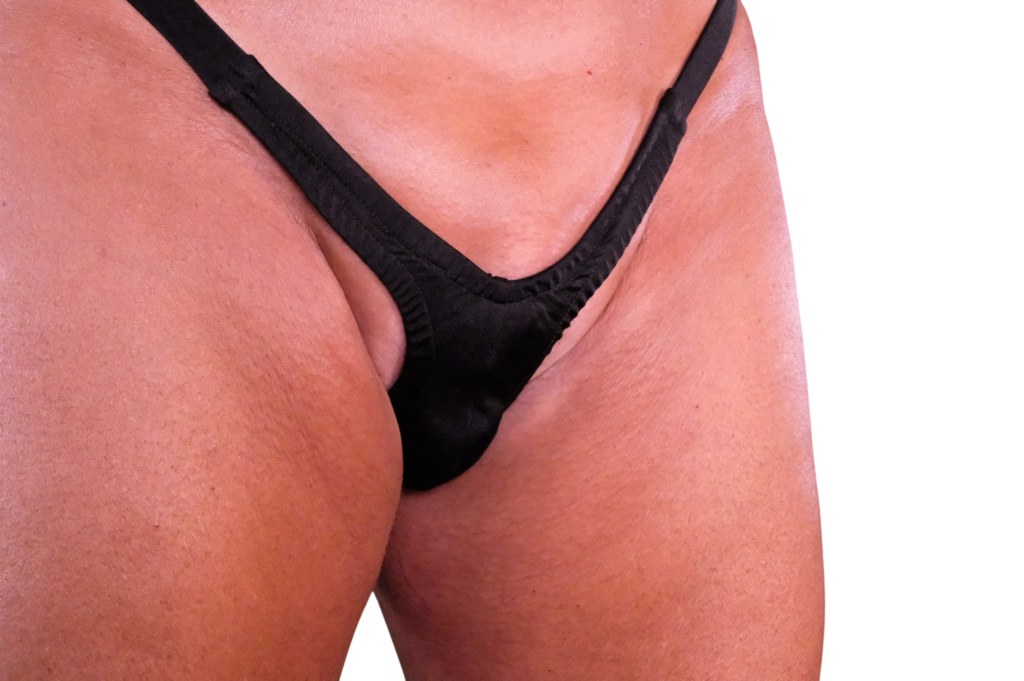
Gender-Fluid Swimwear That Visually Erases the Penis: A Guide to Smooth, Flat and Feminine Swimwear Silhouettes
Gender-fluid swimwear is changing the assumption that a swimsuit designed for someone with male anatomy must emphasize a traditionally masculine bulge. A growing range of swimwear instead does exactly the opposite: it minimizes, conceals or visually “erases” the penis to create a smooth, flat, androgynous or feminine-looking front.
The word erase is important to understand correctly. The anatomy does not literally disappear. Rather, specialized swimwear uses compression, shaping, positioning, coverage and optical design to make external genital contours far less noticeable.
For some wearers, the desired result is a neutral silhouette in which gender is difficult to determine from the swimsuit alone. Others want the appearance of a traditionally feminine bikini bottom. Some transgender and transfeminine people use these designs as gender-affirming swimwear, while some cisgender men simply prefer the appearance or enjoy experimenting with feminine and gender-fluid fashion.
The result is an emerging category that challenges one of the oldest assumptions about men’s swimwear:
A swimsuit doesn’t have to advertise the anatomy underneath it.
What Is Gender-Fluid Swimwear?
Gender-fluid swimwear moves beyond the traditional division between “men’s” and “women’s” swimsuits.
Conventional men’s swim briefs generally provide additional space in front for external genital anatomy. Many designs go further by deliberately shaping the pouch to make the anatomy more visible.
Traditional women’s bikini bottoms generally do the opposite. Their fronts tend to create a relatively smooth silhouette.
Gender-fluid swimwear can borrow from either approach—or combine elements of both.
A swimsuit could have the basic proportions of a men’s bikini while producing a smooth front. Another might have the high legs, narrow sides and cheeky rear traditionally associated with women’s bikinis while being constructed to accommodate a wearer with a penis.
The objective isn’t necessarily to make the wearer appear male or female.
It is to give the wearer control over the silhouette.
The Traditional Men’s Swimsuit Is Built Around the Bulge
For decades, fitted men’s swimwear has generally treated a visible front contour as unavoidable.
Many modern designs actively emphasize it.
Pouches can be contoured, lifted or anatomically shaped. Some are deliberately designed to make the front look larger and more prominent.
But that represents only one possible aesthetic.
What if the wearer wants the exact opposite?
What if someone wants to wear a tiny bikini without having a prominent male outline in front?
What if a man loves women’s bikini styling and wants a similar smooth appearance?
What if a gender-fluid wearer doesn’t want their swimsuit immediately categorizing their body as male?
Those questions have helped produce an entirely different philosophy of swimwear design:
Instead of designing around the bulge, design around reducing it.
What Does “Erasing the Penis” Mean in Swimwear?
In fashion terms, penis-erasing or gender-erasing swimwear refers to creating the visual impression that there is little or no obvious external genital projection.
This can be accomplished to different degrees.
A mild minimizing swimsuit simply reduces prominence.
A stronger compression design can produce a substantially flatter profile.
Tucking-compatible swimwear can create an even smoother appearance for wearers who choose to tuck.
Other specialized designs use shaping and visual construction to create a more conventionally feminine bikini silhouette.
The desired result depends entirely on the wearer.
Someone may want smaller.
Someone else may want smooth.
Another wearer may want androgynous.
Another may want fully feminine-looking.
These are related goals, but they aren’t identical.
The Smooth-Front Bikini
One of the simplest approaches is the smooth-front bikini.
Instead of creating an anatomical pouch, the front is constructed to discourage projection.
Stretch material holds the anatomy closer to the body while a carefully shaped outer panel creates a cleaner visual line.
This can produce a surprisingly different appearance from a conventional men’s bikini.
From the rear, the swimsuit might already resemble a women’s bikini.
With the prominent male pouch removed from the front, the entire garment becomes much more gender-neutral.
That illustrates how much of the perceived gender of a swimsuit comes from its construction rather than the amount of fabric it contains.
Compression Swimwear
Compression provides another approach.
A compression swimsuit uses relatively firm stretch material to hold the front closer to the body.
The objective should be smoothing rather than painful squeezing.
Good compression distributes pressure across a larger area instead of concentrating it at one point.
Different levels of compression can produce very different results.
Light compression reduces definition.
Moderate compression can create a significantly smoother profile.
Specialized gender-affirming swimwear may combine compression with additional internal construction to produce greater flattening.
The ideal design is one that creates the desired appearance while remaining wearable and secure.
Tucking Swimwear
For people seeking a particularly flat front, tucking-compatible swimwear is another option.
These garments are designed to help hold a tuck more securely than an ordinary bikini bottom.
They may incorporate:
- Firm stretch fabrics
- Reinforced front panels
- Wider or stronger gusset construction
- Secure leg openings
- Carefully positioned seams
- Additional internal support
- High-tension front materials
A well-designed tucking swimsuit can create a dramatically different silhouette from conventional men’s swimwear.
Instead of seeing a pouch projecting forward, the viewer sees a much smoother bikini front.
Tucking should not cause pain, numbness or significant discoloration. If it does, the position or compression needs to be changed.
You Don’t Necessarily Have to Tuck
This is an important distinction.
A smooth-front swimsuit doesn’t automatically require traditional tucking.
Some people don’t want to tuck.
Others find it uncomfortable.
Some simply want to reduce the appearance of the front rather than make it completely flat.
That has created demand for non-tucking minimizing swimwear.
These designs use compression, positioning and strategically shaped panels to make the front appear smaller without requiring the wearer to maintain a full tuck.
The visual result may not be identical to traditional tucking, but it can still substantially change the silhouette.
For many wearers, that is enough.
From Male Bikini to Gender-Neutral Bikini
Consider a conventional men’s bikini with a prominent anatomical pouch.
Now imagine changing only the front.
Remove the contour.
Flatten the panel.
Increase compression.
Reduce seams that emphasize anatomy.
The swimsuit immediately becomes more ambiguous.
Now add high-cut legs.
Narrow the sides.
Use a Brazilian rear.
Perhaps add a scrunch seam.
Suddenly the swimsuit might look much closer to a women’s bikini than a conventional men’s brief.
Nothing about the wearer’s identity necessarily changed.
The visual language of the garment changed.
That is at the heart of gender-fluid swimwear.
The Feminine Bikini Silhouette
Some wearers don’t want ambiguity. They specifically want femininity.
For them, simply reducing the bulge may not be enough.
A feminine bikini silhouette can incorporate several design elements at once:
Smooth front: reduces obvious external contours.
Higher-cut legs: borrows proportions commonly found in women’s swimwear.
Narrow sides: creates a more delicate bikini appearance.
Lower or shaped waist: changes the proportions around the hips.
Brazilian or cheeky rear: creates styling traditionally associated with women’s bikinis.
Scrunch-back construction: further shifts the visual emphasis toward the buttocks.
When these elements are combined, the swimsuit can dramatically alter how the lower body is visually presented.
Gender-Fluid Swimwear Doesn’t Have to Mean MTF
It is tempting to assume that anyone wanting to visually eliminate a male bulge must be transgender.
That isn’t necessarily true.
Gender identity and fashion presentation aren’t the same thing.
A transgender woman might choose a smooth-front bikini because it helps her achieve a gender-affirming appearance.
A nonbinary person might want an anatomically ambiguous silhouette.
A gender-fluid wearer might alternate between pouch-enhancing and smoothing swimsuits depending on how they want to present that day.
A cisgender man might simply enjoy feminine bikini fashion.
Someone else may simply dislike the appearance of a prominent swimsuit pouch.
All are legitimate reasons for choosing a particular garment.
MTF Swimwear and Gender-Affirming Design
For transgender women and transfeminine people, smooth-front and tucking swimsuits can serve a more specific purpose.
Conventional men’s swimwear may emphasize exactly the feature they would prefer not to display.
A gender-affirming swimsuit reverses that relationship.
Instead of forcing the wearer to adapt to a swimsuit designed around a male silhouette, the swimsuit is designed around the silhouette the wearer wants to create.
This can be especially important with bikinis because there is relatively little fabric available to disguise contours.
Thoughtful pattern design therefore becomes critical.
Can a Tiny Bikini Still Create a Smooth Front?
Yes, although the engineering becomes more challenging as the swimsuit becomes smaller.
A larger bikini provides designers with more material for compression and internal support.
A micro bikini provides considerably less.
That means a successful smooth-front micro design has to use its limited fabric efficiently.
Material tension becomes more important.
Panel orientation becomes more important.
Seams become more important.
Secure side construction becomes more important.
The objective is to make the swimsuit smaller without losing control of the silhouette.
That is one of the more interesting technical challenges in modern micro swimwear.
Gender-Fluid Micro Swimwear
Micro swimwear takes this concept into especially interesting territory.
Traditionally, extremely small men’s swimsuits often emphasized anatomy because a tiny pouch naturally drew attention to the front.
Gender-fluid micro swimwear can reverse that formula.
The swimsuit gets smaller.
And the apparent bulge gets smaller with it.
The resulting aesthetic can be dramatically different: narrow sides, tiny rear coverage and a surprisingly smooth front.
Instead of the micro swimsuit saying, “Look at the pouch,” it says, “Look at the entire body and the swimsuit.”
That subtle change completely alters the visual effect.
Ultra-Micro Smooth-Front Designs
Ultra-micro swimwear pushes the concept toward its practical limits.
These swimsuits can use extremely narrow sides and minimal front and rear panels.
Creating a smooth silhouette with so little material requires careful construction and correct sizing.
Ultra-micro should describe the amount of coverage, not an unsafe level of tightness.
Trying to create a flatter appearance simply by wearing a swimsuit several sizes too small can cause excessive pressure without producing a good aesthetic result.
Purpose-designed compression and shaping are much better solutions.
Spandex Makes Gender-Erasing Designs Possible
Stretch textiles are central to this category.
Spandex and elastane blends can conform to the body while applying controlled tension.
Designers can manipulate:
- Stretch direction
- Fabric weight
- Panel shape
- Seam placement
- Layering
- Compression
- Waistband tension
- Leg-opening tension
These variables allow a very small garment to perform surprisingly complex shaping.
This is why two bikinis that appear almost identical when lying on a table can produce completely different silhouettes when worn.
Fabric engineering matters.
Color and Pattern Can Help Change the Silhouette
The visual effect isn’t created exclusively through compression.
Color and pattern also influence perception.
Dark colors and low-contrast patterns can make contours less obvious.
Strategically placed prints can distract from anatomical outlines.
Seams can either draw attention toward the center front or deliberately direct the eye elsewhere.
Color blocking can visually reshape the proportions of the bikini.
These are familiar fashion techniques, but gender-fluid swimwear can use them specifically to control how the front silhouette is perceived.
The Rear Can Be Just as Important as the Front
Creating a more feminine or gender-fluid appearance isn’t exclusively about hiding a bulge.
The rear of the swimsuit matters too.
A conventional men’s racing brief generally uses relatively broad rear coverage.
Women’s bikinis frequently offer much greater variation.
Gender-fluid swimwear can borrow from:
- Brazilian cuts
- Cheeky rears
- High-cut legs
- Thong backs
- G-string construction
- Scrunch backs
- V-shaped waistlines
These details shift visual attention away from the front and toward the overall shape of the swimsuit and body.
For someone seeking a feminine presentation, that can be just as important as flattening the front.
Masculine One Day, Feminine the Next
One of the most interesting possibilities created by modern swimwear is the ability to change presentation without permanently changing anything about the body.
One day a wearer might choose an anatomical pouch bikini that strongly emphasizes a masculine silhouette.
Another day they might choose a compression bikini.
Another time they might wear a smooth-front gender-neutral design.
And another time they might choose a tucking bikini with high-cut legs and a Brazilian rear for a strongly feminine presentation.
That freedom is exactly what the term gender-fluid swimwear can represent.
The swimsuit becomes a tool for changing presentation.
Choosing the Right Gender-Fluid Swimsuit
Start by deciding what you actually want the swimsuit to accomplish.
If you simply want less bulge, look for a minimizing or compression front.
If you want a smooth gender-neutral appearance, prioritize flat construction and avoid strongly anatomical seams.
If you want a very flat appearance, specialized tucking swimwear may be appropriate.
If you want a feminine bikini appearance, consider the entire garment rather than concentrating exclusively on the front. High legs, narrow sides and rear styling can make an enormous difference.
If you want micro or ultra-micro coverage, choose a swimsuit specifically engineered to combine minimal fabric with the level of smoothing you want.
The right swimsuit depends on the desired result.
Fit and Comfort Still Matter
A swimsuit shouldn’t need to hurt to create a smooth appearance.
This is particularly important with compression and tucking designs.
Remove or adjust the garment if you experience pain, numbness, persistent tingling, significant discoloration, skin injury or other signs of excessive pressure.
Also remember that smaller isn’t synonymous with tighter.
A properly designed micro bikini achieves its tiny appearance through pattern dimensions.
It shouldn’t depend on extreme compression merely because the wearer purchased the wrong size.
Comfort and appearance can coexist.
A New Definition of Men’s Swimwear
For decades, men’s fitted swimsuits largely offered two choices:
Hide the body under shorts or display a masculine silhouette in briefs.
Gender-fluid swimwear introduces a third possibility.
Transform the silhouette itself.
A swimsuit can visually minimize anatomy.
It can create ambiguity.
It can create smoothness.
It can borrow the proportions of women’s bikinis.
It can allow someone with male anatomy to present a conventionally feminine-looking swimsuit silhouette.
And it can do so without requiring the wearer to explain or define their identity.
That represents a significant expansion of what men’s and gender-inclusive swimwear can be.
Frequently Asked Questions About Gender-Fluid Swimwear
Can a swimsuit really make a penis look like it isn’t there?
A swimsuit cannot literally remove anatomy, but compression, positioning, tucking and specialized panel construction can substantially reduce visible external contours and create a much smoother appearance.
Do I have to tuck to get a flat swimsuit front?
Not necessarily. Compression and minimizing swimsuits can reduce projection without a full tuck. Tucking-compatible swimwear is an additional option for people seeking a flatter result.
Is smooth-front swimwear only for transgender women?
No. Transgender women are one important audience for gender-affirming swimwear, but nonbinary, gender-fluid and cisgender people may also prefer a smooth-front swimsuit.
Can a men’s bikini look like a women’s bikini?
Yes. High-cut legs, narrow sides, Brazilian or cheeky rears and smooth-front construction can make the visual differences between men’s and women’s bikini styling surprisingly small.
Can micro swimwear minimize the front?
Yes. Specialized micro designs can use compression and shaping, although the smaller amount of fabric makes construction and fit particularly important.
Is compression supposed to be uncomfortable?
No. Firmness and pain aren’t the same thing. A compression swimsuit should provide controlled support without causing pain, numbness, skin damage or significant circulation problems.
The Future: Swimwear Without Gender Rules
Perhaps the future of swimwear isn’t about creating increasingly separate men’s and women’s categories.
Perhaps it is about letting people choose individual characteristics.
Choose your coverage.
Choose your front profile.
Choose your rear coverage.
Choose your leg height.
Choose your colors.
Choose masculine styling.
Choose feminine styling.
Choose neither.
Choose both.
For someone with male anatomy, that could mean wearing an anatomical pouch one day and a smooth-front bikini the next.
For a transgender woman, it could mean finally finding a bikini designed around the silhouette she wants rather than the anatomy designers assume she should display.
For a gender-fluid wearer, it could mean having an entire wardrobe of different presentations.
The important development is choice.
Final Thoughts: When the Bulge Becomes Optional
Gender-fluid swimwear is challenging one of the most persistent conventions in men’s swimwear: the assumption that male anatomy must be visually obvious.
It doesn’t.
Modern stretch fabrics, compression panels, tucking-compatible construction, smooth-front designs and increasingly sophisticated bikini patterns give wearers much greater control over their appearance.
The penis isn’t literally erased.
Its visual presence can be minimized to the point that it no longer defines the swimsuit’s silhouette.
That distinction opens an entirely new direction for swimwear.
A person with male anatomy can choose a traditional pouch.
A small pouch.
A compression front.
A smooth front.
A tucked appearance.
A gender-neutral silhouette.
Or a strongly feminine bikini presentation.
And these ideas can be incorporated into everything from conventional swim briefs and high-cut bikinis to Brazilian cuts, thongs, micros and ultra-micros.
Ultimately, that may be the most meaningful thing about gender-fluid swimwear.
Instead of allowing anatomy to determine what the swimsuit must look like, the wearer gets to decide what they want the swimsuit—and themselves—to look like.